Search results for
1960's movie with bodies in plaster statues

House of Wax
A New York sculptor who opens a wax museum to showcase the likenesses of famous historical figures runs into trouble with his business partner, who demands that the exhibits become more extreme in order to increase profits.

House of Wax
A group of unwitting teens are stranded near a strange wax museum and soon must fight to survive and keep from becoming the next exhibit.
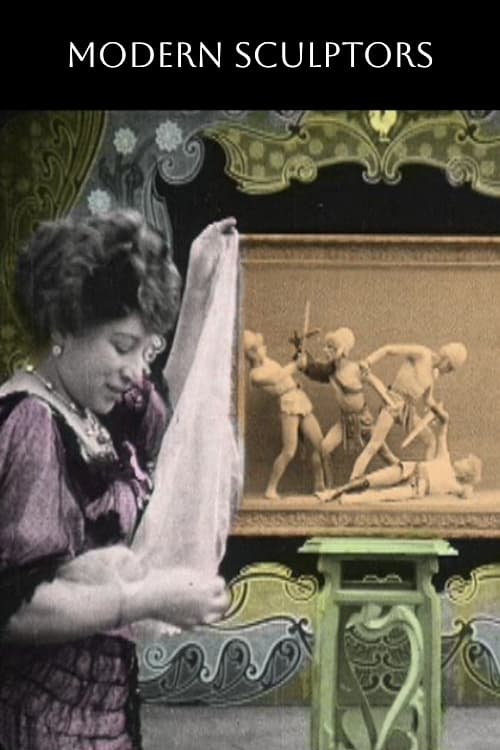
Modern Sculptors
The first scene presents before the astonished eyes of the spectators a solid piece of marble, which the minute it is placed on a table seems to take life, and one can follow a snake-like line branding on the polished face of the stone the name of the house of Pathé Frères. As soon as this stone has been engraved, as by magic, a handsome young lady appears with a huge lump of clay covered with a cloth. As soon as the cloth is removed from the soft mass it starts whirling and turning as if stricken mad, and one is asking one's self what all the contentions are going to lead to, when the vague shape of an animal not yet discernible seems to appear, and before one has time to make one's mind as to the category of brutes to which it belongs one sees the form of a remarkably well made orang-utan modelled out of the clay, who calmly smokes his pipe. Then the statue is removed by the same winning young lady and another covered block of the same substance is carried forward.
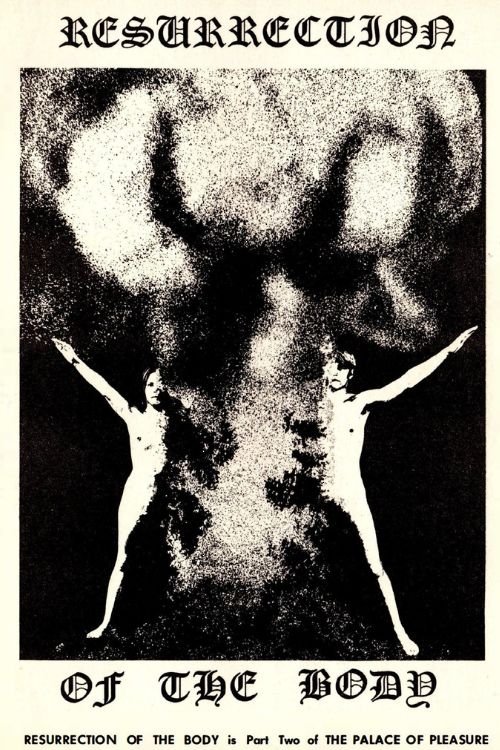
Resurrection of the Body
"In memoriam. Man in pieces. You have the lovers, remade by funhouse mirrors; you have the symmetries, undone, bent and curved; and you have the model, the bag on her head filling with carbon dioxide. Who owns your life? Testimonial and demonstration, a most ominous trade show. An experiment in therapeutic cinema. A speculative sequel and conclusion to John Hofsess's Palace of Pleasure (1967)." — S.B.

Baroque Statues
In an associative montage statues of saints in rigid and rapt poses are cross cut with those of real actors until the two can no longer be told apart. Gradually the real bodies break away from the constraints of their wooden models through increasingly improvised dance. A successful act of liberation from (Catholic) convention, which the material celebrates in an acstasy of multiple exposures and psychedelic colors.

Living Sculptures
"Living Sculptures" shows images transformed into surreal bodies.

Four Unloved Women, Adrift on a Purposeless Sea, Experience the Ecstasy of Dissection
Cronenberg's speculative historical work draws inspiration from the anatomical waxworks at the La Specola museum in Florence, Italy. These wax models, traditionally used for medical demonstrations, are given a new perspective in the film. Cronenberg's work reveals the vibrant and surprising aspects of these female wax corpses, which were previously seen as static and serious. As David Cronenberg explains: “The Specola wax figures were created as a teaching tool, capable of revealing the mysteries of the human body to those who could not access … real cadavers held in universities and hospitals. In their attempt to create whole, partially dissected figures, whose body language and facial expression did not show suffering or agony … the sculptors ended up producing living characters apparently overcome by ecstasy. It was this surprising stylistic choice that captured my imagination: what if it was the dissection itself that induced that tension, that almost religious rapture?”
Rate This Search
How well did these results match your search?