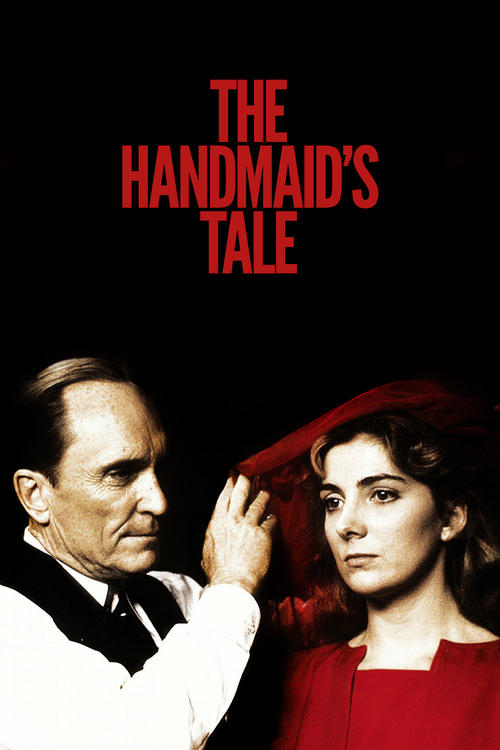
The Handmaid's Tale (1990)
In a dystopian, polluted right-wing religious tyranny, a young woman is put in sexual slavery on account of her now rare fertility.
Details
Budget
$13,000,000
Rating
6/10 (230 votes)
Status
Released
Production Companies
Cinecom Entertainment Group, Cinetudes Films, Neue Bioskop Film
About The Handmaid's Tale
The 1990 film version of "The Handmaid's Tale" adapts Margaret Atwood's dystopian novel, setting its story in a future United States, now a totalitarian religious state called Gilead. The plot centers on Kate, a woman forced into sexual servitude due to her fertility in a society where birth rates have plummeted. Her role as a Handmaid is to provide children for high-ranking, barren couples, stripped of her identity and renamed Offred.
The film explores themes of rebellion, dystopia, and the oppression of women under a fundamentalist regime. It depicts a society rigidly controlled by religious dogma, where women's lives are dictated by their reproductive capacity and social standing. The narrative follows Kate's experiences within this oppressive system, her struggle for survival, and her search for a way out.
Key aspects of the movie include its focus on the protagonist's journey, her interactions with other characters like Serena Joy and the Commander, and the underlying political unrest in Gilead. The film touches on subjects such as sexual slavery, misogyny, and totalitarianism, reflecting the novel's critique of societal control and the erosion of individual freedoms. The movie was released with a runtime of 108 minutes.
Why you might be searching for The Handmaid's Tale
People search for this film to compare it with the more recent TV series adaptation or to find the original cinematic take on Margaret Atwood's novel. Its cast, including Natasha Richardson and Faye Dunaway, and its portrayal of a dystopian, religious fundamentalist society are also common search points.
What reviewers are saying
One reviewer found the 1990 film to be a more effective adaptation than the television series, attributing its success to a concise script and strong performances from actors like Faye Dunaway and Natasha Richardson.
Read the full reviewA review notes the visual style, particularly the use of hairspray, and describes the future setting where women are divided into privileged blues and surrogate reds, with one woman, Kate, assigned to a commander to conceive children.
Read the full reviewFrequently Asked Questions
Common questions about finding and identifying movies
You can stream "The Handmaid's Tale" on [Hulu](https://www.hulu.com/series/the-handmaids-tale-565d8976-9d26-4e63-866c-40f8a137ce5f) and [Disney+](https://www.disneyplus.com/en-is/browse/entity-565d8976-9d26-4e63-866c-40f8a137ce5f). It's also available for purchase on platforms like Amazon Video, Apple TV Store, and Fandango At Home, and on DVD or Blu-ray.
No, "The Handmaid's Tale" is not based on a true story, but it is adapted from the classic dystopian novel by Margaret Atwood. The series depicts a totalitarian society called Gilead, which faces environmental disasters and a declining birthrate, leading to the enslavement of fertile women.
In the series finale of "The Handmaid's Tale", Gilead suffers a significant military loss, with Boston being liberated and restored as an American state. June (Elisabeth Moss) does not reunite with her daughter Hannah in the finale, but she decides to write a book chronicling her experiences as a Handmaid, ending the series by reciting the first page of Margaret Atwood’s novel. The show's creator, Bruce Miller, intended this ending from the beginning, as the book itself implies Offred's story was recorded.
"The Handmaid's Tale" is an Emmy-winning dystopian drama and thriller. It's well-regarded for its portrayal of a woman's struggle for survival in a terrifying, totalitarian society, and it explores themes of power, subjugation, and resistance.