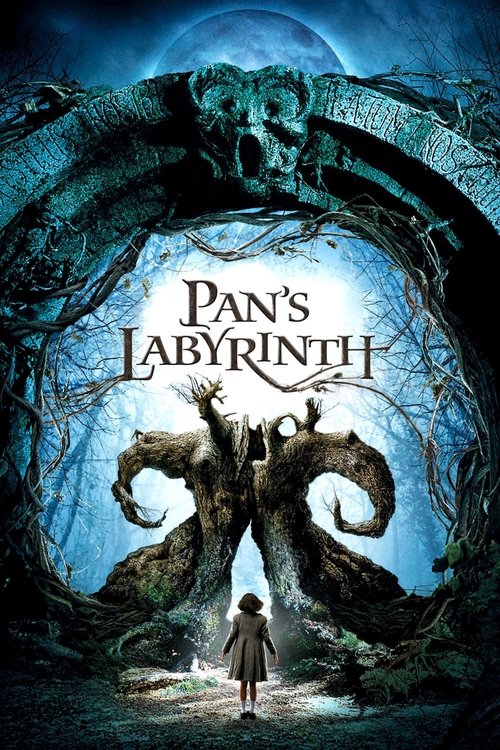
Pan's Labyrinth (2006)
Living with her tyrannical stepfather in a new home with her pregnant mother, 10-year-old Ofelia feels alone until she explores a decaying labyrinth guarded by a mysterious faun who claims to know her destiny. If she wishes to return to her real father, Ofelia must complete three terrifying tasks.
Details
Budget
$19,000,000
Rating
8/10 (10692 votes)
Status
Released
Production Companies
Estudios Picasso, Esperanto Filmoj, Tequila Gang, Telecinco Cinema
About Pan's Labyrinth
Guillermo del Toro's 2006 film, "Pan's Labyrinth," blends fantasy with the harsh realities of post-Spanish Civil War Spain. The story centers on Ofelia, a young girl who escapes her grim surroundings by retreating into a fantastical world populated by magical creatures, including a faun who sets her on a quest. The film weaves together elements of a dark fairy tale with a historical drama, creating a narrative that explores themes of innocence, cruelty, and resistance.
The setting of the Franco regime provides a backdrop of oppression and violence, contrasting sharply with the imaginative world Ofelia creates or discovers. This duality allows the film to function on multiple levels, presenting both a literal fairy tale and a metaphorical exploration of a child's coping mechanisms in the face of brutality. The visual style and creature design are distinct, contributing to the film's atmosphere.
The film has been noted for its critical reception, with high scores on Rotten Tomatoes and Metacritic, and a strong IMDb rating. It is categorized as a fantasy, drama, and war film, reflecting its blend of genres. Key elements that define the movie include its portrayal of a princess, an army, the resistance movement, and its engagement with the Franco regime.
Why you might be searching for Pan's Labyrinth
People search for "Pan's Labyrinth" often because of its unique blend of dark fantasy and historical drama, particularly its iconic faun and other creatures. Its themes of childhood imagination as an escape from a brutal reality, set against the backdrop of the Spanish Civil War, also make it memorable. The film's ambiguity, leaving viewers to question what is real and what is imagined, also contributes to its lasting impact.
What reviewers are saying
One reviewer found the movie beautiful with a good World War II-era plot, but felt it prioritized style over substance, though they praised the acting of Ivana Baquero.
Read the full reviewAnother reviewer considers this their favorite Guillermo del Toro film, noting it improves with rewatching, and describes Ofelia's journey into a potentially dangerous nether world as a search for her inheritance as a princess.
Read the full reviewA reviewer highlighted that the film encourages thought, allowing for interpretations of Ofelia's story as either a dark fairy tale or a coping mechanism through imagination, and appreciates that the film does not definitively resolve which interpretation is correct.
Read the full reviewFrequently Asked Questions
Common questions about finding and identifying movies
No, Pan's Labyrinth is not based on a true story, but it is set against the backdrop of Francoist Spain in 1944, during the Spanish Civil War. Director Guillermo del Toro considers the film a parable, influenced by fairy tales.
In the climax of Pan's Labyrinth, Ofelia refuses the Faun's request to shed her baby brother's blood to open a portal to the underworld. Her stepfather, Captain Vidal, shoots her. As Ofelia dies, drops of her blood fall onto an altar in the labyrinth, and she awakens in a golden throne room in the underworld. There, her parents, the King and Queen, tell her that by choosing to spill her own blood rather than another's, she passed the final test, and she reigns with them for centuries. Director Guillermo del Toro has stated that while he believes the fantasy underworld is real within the film's context, he intended for the movie's interpretation to be a matter of personal discussion.
Pan's Labyrinth is widely considered a highly acclaimed film, receiving a 95% score on Rotten Tomatoes and a 98/100 score on Metacritic. Critics have praised its visual effects, direction, and storytelling, often calling it "Alice in Wonderland for grown-ups" for its blend of fantasy and harsh reality.