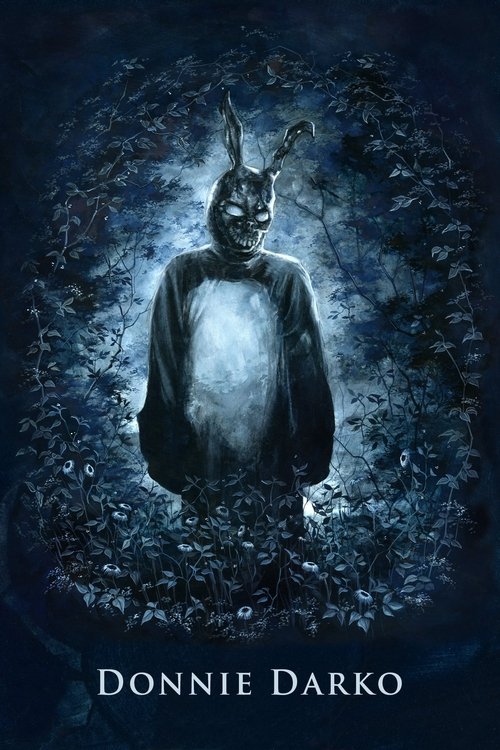
Donnie Darko (2001)
After narrowly escaping a bizarre accident, a troubled teenager is plagued by visions of a large bunny rabbit that manipulates him to commit a series of crimes.
Details
Budget
$4,500,000
Rating
8/10 (12636 votes)
Status
Released
Production Companies
Flower Films, Gaylord Films, Adam Fields Productions, Pandora Cinema
About Donnie Darko
Richard Kelly's 2001 film "Donnie Darko" is a blend of fantasy, drama, and mystery that explores the troubled mind of its teenage protagonist. The narrative centers on Donnie, who experiences visions of a rabbit figure after a strange accident. These visions compel him to engage in various acts, creating a complex interplay between his perceived reality and the events around him.
The film delves into themes of mental illness, time travel, and suburban life in the 1980s. Donnie's interactions with his family, school, and therapist paint a picture of a young man struggling with his perceptions. The storyline keeps the audience guessing whether Donnie's experiences are a product of his psychology or something more supernatural. Its enduring appeal is partly due to its layered plot and the different interpretations it allows.
"Donnie Darko" has developed a cult following since its release, recognized for its unique atmosphere and narrative structure. The film's psychological elements and surrealism contribute to its distinct identity. It is a movie that invites discussion and repeated viewings to uncover its various interpretations.
Why you might be searching for Donnie Darko
People often search for "Donnie Darko" due to its mind-bending plot involving a giant rabbit, time travel, and a teenage protagonist in a psychological thriller. The movie is known for its unique atmosphere and complex narrative that leaves viewers questioning reality.
What reviewers are saying
One reviewer noted that the movie has multiple interpretations and, similar to "2001: A Space Odyssey," benefits from understanding the director's intended explanation if one is interested in the underlying meaning.
Read the full reviewA review highlighted the film as a "mind-bender" that brought Jake Gyllenhaal to prominence, introduced a memorable creepy rabbit costume, and made the song "Mad World" emotionally impactful for them.
Read the full reviewA viewer described the film as strange and bizarre, featuring a complex plot where a teenager commits crimes under the influence of an imaginary rabbit, prompting questions about schizophrenia or other psychological conditions.
Read the full reviewOne reviewer mentioned that Jake Gyllenhaal's character, Donnie, is a troubled teenager who struggles to fit in, finding solace on a psychiatrist's couch, and whose journey begins after an aircraft engine crashes into his home.
Read the full reviewFrequently Asked Questions
Common questions about finding and identifying movies
You can watch *Donnie Darko* on streaming services like Netflix or rent/buy it on platforms such as Amazon Prime Video and Apple TV.
No, *Donnie Darko* is not based on a true story. Writer-director Richard Kelly developed the initial idea from an urban legend he heard as a child about a piece of ice falling from a plane wing and crashing into a boy's bedroom, which led him to imagine a jet engine falling onto a house. He also incorporated concepts of time travel and alternate universes from Stephen Hawking's *A Brief History of Time*.
The ending of *Donnie Darko* involves Donnie sacrificing himself to save the primary universe. In the film, a jet engine from an alternate "tangent universe" crashes into Donnie's bedroom, and if this "artifact" isn't returned to the primary universe within 28 days, the primary universe will be destroyed. Donnie, as the "living receiver," gains superhuman abilities and is guided by the "manipulated dead" (like Frank and Gretchen) to return the engine by dying in his bed as it falls, resetting the timeline and preventing the collapse of the universe.
*Donnie Darko* is generally well-regarded, with critics calling it a "daring, original vision" and praising Jake Gyllenhaal's performance. The theatrical version has a weighted average score of 71 out of 100 on Metacritic, and the director's cut received "universal acclaim" with a score of 88 out of 100.