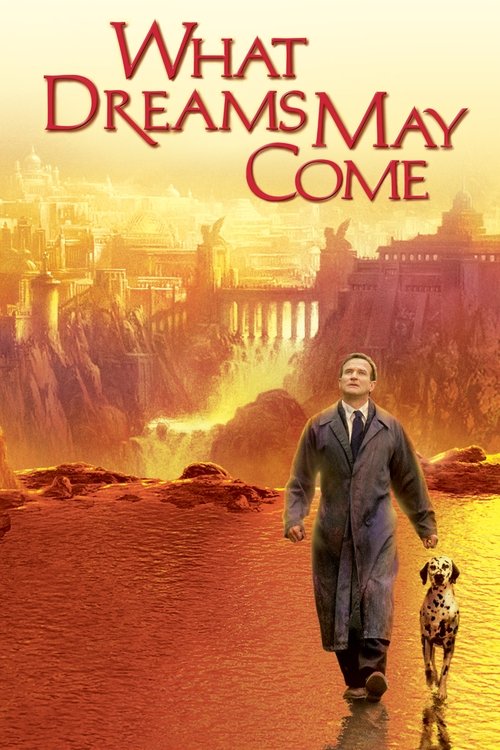
What Dreams May Come (1998)
Chris Neilson dies to find himself in a heaven more amazing than he could have ever dreamed of. There is one thing missing: his wife. After he dies, his wife, Annie killed herself and went to hell. Chris decides to risk eternity in hades for the small chance that he will be able to bring her back to heaven.
Details
Budget
$85,000,000
Rating
7/10 (2331 votes)
Status
Released
Production Companies
PolyGram Filmed Entertainment, Interscope Communications, Metafilmics
About What Dreams May Come
The 1998 film "What Dreams May Come" blends drama, fantasy, and romance to explore themes of life, death, and the enduring power of love. The narrative centers on Chris Neilson, who finds himself in an otherworldly paradise after his death. His new existence, however, is incomplete without his wife, Annie, who has died by suicide and is consequently in hell. Chris then embarks on a perilous journey to rescue her, risking his own eternal peace for the chance to reunite.
The film delves into the concepts of heaven and hell, depicting them not as traditional religious locales but as reflections of individual perception and memory. The visual style uses vibrant imagery to represent these spiritual realms, particularly Chris's personalized heaven. This visual approach supports the narrative's focus on soulmates and the profound connection between a husband and wife, even across the divide of death. The story also touches on the intense grief and loss that can lead individuals to despair, portraying Annie's struggle after multiple tragedies.
Why you might be searching for What Dreams May Come
People often search for this film due to its distinct visual style, its unique portrayal of the afterlife, and its emotional narrative about a husband's journey through heaven and hell to find his soulmate. The themes of reincarnation, car accidents, and the quest for a loved one after death are also frequently associated with searches for this movie.
What reviewers are saying
One reviewer mused on the potential real-world parallels between Robin Williams' character, Chris, who navigates immense emotional challenges, and the actor's own later life. The review outlines Chris's journey after a fatal car crash, his arrival in heaven, and his subsequent decision to descend into hell to retrieve his wife, Annie, after her suicide, driven by the belief that true love can overcome all obstacles.
Read the full reviewFrequently Asked Questions
Common questions about finding and identifying movies
You can stream *What Dreams May Come* on Netflix and Prime Video.
*What Dreams May Come* is a fantasy drama film adapted from Richard Matheson's 1978 novel, not a true story. The novel itself drew on various paranormal and New Age beliefs for its depiction of the afterlife, with the author stating that only the characters were fictional. However, the film significantly alters the novel's plot and its vision of the afterlife, including elements like astral projection and telepathy which are present in the book but not the movie.
In *What Dreams May Come*, Chris journeys into Hell to rescue his wife, Annie, after she dies by suicide. He finds her suffering from amnesia and trapped in a nightmarish version of their home. Instead of returning to Heaven, Chris chooses to stay with Annie in Hell, which triggers her memory. They then ascend to Heaven together, reunite with their children, and decide to reincarnate to experience life together again, meeting as children in a situation mirroring their first encounter. An alternate ending on the DVD, closer to the novel, has their children explain that Annie must return to Earth to complete her next life naturally due to her suicide, and Chris offers to go with her, leading to their meeting again as children.
*What Dreams May Come* received mixed reviews upon its release, with critics praising its stunning visual effects and scenery but often criticizing the plot as insubstantial. Roger Ebert noted its breathtaking imagination and heartbreaking performances by Robin Williams and Annabella Sciorra, but felt the ending became too conventional. Despite its flaws, it won an Academy Award for Best Visual Effects.